
2026 marks 40 years of Results UK. To celebrate, throughout the year we are inviting contributors to write blogs exploring different ways of approaching and framing international development. This is the second of the series and is written by Results UK’s Parliamentary Advocacy Officer for Tuberculosis, Aqsa Shah. In this piece, Aqsa explores the often overlooked role that diaspora communities play in development financing.
In mid-2024, I wrote about the untapped power of diaspora communities in shaping an alternative model of global development – one built less on formal institutions and more on identity, trust, and collective memory. Since then, the global landscape has shifted dramatically: aid budgets have tightened, humanitarian crises have intensified and governments have been forced to rethink how development is financed. But while institutions debate strategy and delay action, one form of development finance has never stopped delivering: remittances.
Each year, migrants send hundreds of billions of pounds back to their countries of origin – often far exceeding official development assistance budgets. Yet remittances are usually discussed only as financial flows. This framing wrongly characterises remittances as simply economic transactions. This is not the case: they are expressions of identity, obligation, and trust. Remittances demonstrate that personal relationships are at the very core of development financing.
This is not abstract. It is money sent from Birmingham to a farm shop owner in Jhelum, Pakistan to put together parcels of rice, lentils, and sugar to feed families who can’t afford enough to eat. It is old Biff, Chip and Kipper books packed up and sent abroad so children in rural communities can have something to read and develop their English skills. It is phones and tablets that we have outgrown being passed on to help relatives stay connected, access online services and build businesses. I have seen countless families, my own included, take part in this kind of giving – small, thoughtful gestures rooted in identity that quietly strengthen communities and help them thrive.
Over time, these acts accumulate to deliver tangible impact. Some happen quietly, such as funding boreholes in rural districts to secure access to safe water. Others emerge in moments of crisis – rebuilding homes, schools and clinics after floods or earthquakes. In this sense, diaspora communities are not simply supplementing development. They are practising a relational model that is shaped by faith, culture, family and shared history and is often able to respond faster than formal mechanisms because they are built on trust and a unique understanding of the needs of the community.
Faith networks frequently provide both motivation and infrastructure for diaspora action. Mosques in the UK, like Green Lane Masjid in Birmingham, organise charity drives during Ramadan to raise funds to deliver food packages in countries like Syria. Sikh gurdwaras like Gurdwara Sahib Leamington and Warwick are known to mobilise langar kitchens, fundraising drives, and volunteer teams to respond to increasingly frequent floods in Punjab, a consequence of climate change. Churches, synagogues, and temples also act as hubs for connecting people, pooling resources, and coordinating efforts – making it possible for small individual contributions to become large-scale support.
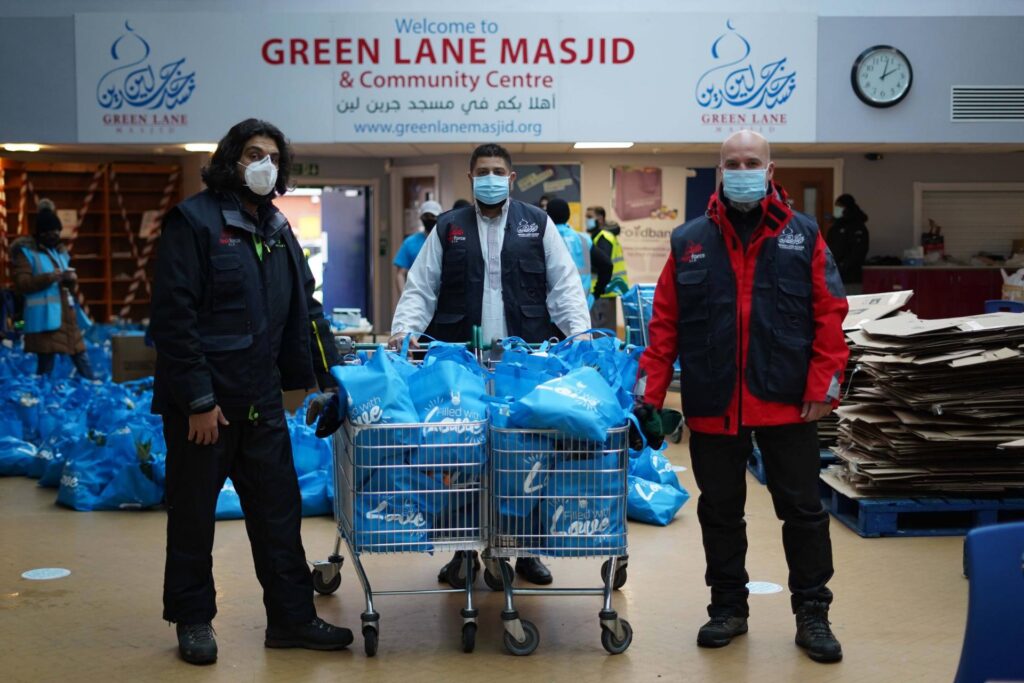
credit: Green Lane Masjid
Cultural identity also drives organised action. Shared practices and networks, from university societies like Afro-Caribbean Society (ACS) and Asian Societies (ASoc) to music and dance groups or local community organisations, often translate social connection into fundraising and volunteering for projects in countries of origin. Almost every diaspora community has a term for a rotating savings or credit association (ROSCA). This is when a group of community members (usually elders) contribute a fixed amount of money into a shared pot, saving and borrowing together, and taking turns to withdraw the total.
I grew up calling it kameti, but similar arrangements exist worldwide: cundinas de dinero in Mexico and pandero in Peru, hui in China, mu round in Zimbabwe, and pardners in Jamaica. Beyond meeting personal needs, these pooled funds frequently finance school fees, medical treatment, housing construction, small business start-ups, and community infrastructure back home.
Festivals and cultural celebrations operate similarly. What appears to be purely social gathering often doubles as financial mobilisation: ticket sales, raffles and collections channel resources toward flood relief, hospital equipment, scholarships or water projects abroad. Culture, in this sense, is not symbolic. It is a financial instrument, a mechanism through which diaspora communities mobilise capital quickly, collectively and with high levels of trust.
Family and shared history further sustain diaspora engagement. Many communities carry forward patterns of giving that span generations, shaped by experiences of migration, displacement, or hardship. Parents, grandparents, and extended relatives instil values of responsibility and solidarity, and these lessons often translate into concrete acts like mentoring younger community members and supporting long-term development projects in their homeland. It’s this interweaving of history, family, and lived experience that sustains diaspora engagement over decades, turning personal connections into enduring social impact.
Diaspora action is shaped by emotion, as well as by identity and history. Pride, solidarity, and a sense of responsibility motivate people to contribute, mentor, and mobilise resources across borders. At the same time, feelings of guilt, worry, or helplessness about conditions back home can push communities to act, sometimes urgently. These emotional currents are deeply intertwined with family ties, shared history and faith, creating a powerful, sustained engine for development. They help explain why diaspora communities repeatedly step in where institutions cannot, and why their contributions – financial, material, or relational – often endure across decades.
In an era where formal aid systems are under strain, diaspora communities are quietly demonstrating another model of development. Their work is not episodic or transactional; it is relational and grows from the belief that responsibility does not end at a border, and that prosperity is something to be shared. When governments rethink financing and institutions debate strategy, diaspora networks are already acting: moving resources, transferring knowledge, mentoring across generations, and sustaining communities in ways that rarely make headlines but endure. Recognising diaspora power is not about romanticising generosity – it is about understanding that development is as much a social and emotional infrastructure as it is an economic one. And in that infrastructure, diaspora communities are not peripheral actors – they are central.