
2026 marks 40 years of Results UK. To celebrate, throughout the year we are inviting contributors to write blogs exploring different ways of approaching and framing international development. This is the third of the series and is written by Dr Rebecca Cooper, Labour MP for Worthing West.
There is a particular kind of political failure that happens not with a bang but with a shrug. When the United States completed its withdrawal from the World Health Organisation on 22 January this year, it was precisely that kind of moment, consequential, telling, and met in Britain with little more than a news cycle before the world moved on.
That should trouble us. Not because Britain must defend every international institution out of reflex, but because we have failed to explain to ordinary people why these institutions matter to their lives. That failure is not merely a communications problem. It is a strategic vulnerability.
the moment we nearly grasped
It was not long ago that global health sat at the very centre of national life. COVID-19 made that unavoidable. For a period, the connection between health systems thousands of miles away and life here at home was viscerally, undeniably real. A virus that emerged on the other side of the world shut our economy, overwhelmed our NHS, kept us from our families, and caused devastating loss.
Suddenly, the R number, vaccine supply chains, and international surveillance networks were debated at kitchen tables across the country. The lesson felt inescapable: Britain’s security is inseparable from the health of systems far beyond our borders.

“It’s not long ago that global health sat at the very centre of national life.”
Professor Chris Whitty and Andrew Pollard holding a Downing Street briefing on UK coronavirus rates. Credit: Pippa Fowles
But we were too quick to forget. The exhaustion and politicisation of the pandemic years created a powerful desire to turn the page. Global health slipped back into technical briefings and specialist forums. The institutions designed to detect and contain the next outbreak once again operate largely outside mainstream debate. Some face active attack. Others face something quieter but equally dangerous: erosion through neglect, because too few people are making the case for what they actually do.
what happens when we stop explaining
Last year, Britain co-hosted the replenishment of the Global Fund to Fight AIDS, Tuberculosis and Malaria alongside South Africa. Around the same time, donors gathered to determine the next funding round for Gavi, the Vaccine Alliance – decisions that will shape whether hundreds of millions of children receive routine vaccinations against measles and polio, and whether frontline health workers in the world’s poorest countries have the tools to stop outbreaks before they spread. These are consequential moments. They generated almost no mainstream public debate in Britain.
When political leaders fail to articulate the purpose of global health investment, the story fills itself in, and not in our favour. “Foreign aid” becomes detached from any notion of national interest. Multilateral organisations are reduced to acronyms. Funding rounds appear abstract, optional, the first thing to cut when money is tight.

MPs Dr Beccy Cooper, Lauren Sullivan, Kevin McKenna and Sojan Joseph visited the Global Fund offices in Geneva in October 2025. Credit: Will Sewell / Results UK
But these institutions are not peripheral. The Global Fund supports the diagnostics, treatments and health workers that keep HIV, tuberculosis and malaria from overwhelming communities with no other safety net. Drug-resistant TB and antimicrobial resistance are not distant threats; they are growing challenges that directly threaten the future effectiveness of care within our NHS. The WHO coordinates data sharing and outbreak response at a scale no single nation can replicate alone.
These systems detect outbreaks early, accelerate containment, and reduce the probability that something local becomes something global. Pandemic preparedness rarely commands headlines. Until it fails.
the right argument, made the wrong way
The problem is not only that we don’t discuss global health enough. It is that when we do, we tend to reach for the wrong tools.
Too often, the case is made in one of two ways: a technical framing dense with acronyms and institutional jargon, or a moral framing that asks people to care simply because it is the right thing to do. Both fall short. The barrier is not comprehension. It is language that feels remote, that signals, before the argument has even begun, that this is a conversation for specialists. The moral argument, while genuinely compelling, is easily displaced in times of domestic pressure. People do care about those beyond our borders, but they also care about their families, their health, and their livelihoods.
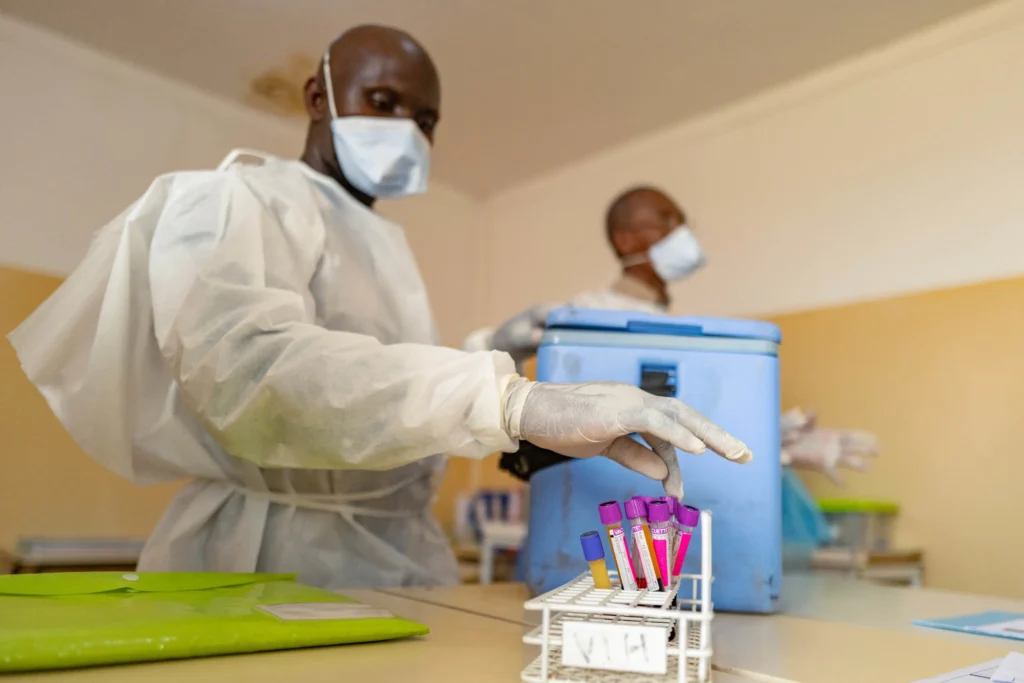
A clinician in Senegal bolstering early disease detection across West Africa. Credit: The Global Fund/Sylvain Cherkaoui
The argument that we should be making is simple and honest: strong health systems abroad make Britain safer and more prosperous at home. This is not charity. It is self-interest. Investing in global health reduces the likelihood of cross-border outbreaks, protects our economy from the kind of disruption we lived through in 2020, and reinforces Britain’s influence in shaping the international systems we will depend upon for decades to come. Our universities, scientists and life sciences sector are world-leading, engagement in global health generates research, jobs and innovation that flow through our economy from laboratory bench to manufacturing floor.
We should also be honest about trade-offs, the public expects that, and they deserve it. But the choice here is not simply between spending and saving. It is between investing in prevention now or paying far more when the next crisis arrives. The false binary between domestic and international priorities, between a strong NHS and strong global systems, is one we must retire.
the case that still needs making
The pandemic gave us a rare and painful moment of clarity. We understood, briefly, that health systems abroad are not remote humanitarian concerns but part of the infrastructure that protects life and livelihood here at home. We cannot afford to wait for another crisis to remind us.
The drivers of infectious disease risk, urbanisation, environmental change, conflict, global mobility, have not diminished. The question is not whether another major outbreak will occur. It is whether the international systems designed to detect and contain it will still be functioning when it does.
This requires us to make the case plainly and consistently. Not because global health institutions should be beyond scrutiny, but because silence cedes the argument to those who would rather not have it at all.
We stopped having this conversation. It is time we started again.