
reduce child undernutrition by tackling illicit financial flows
The countries most affected by child undernutrition collectively experienced $310 billion in ‘trade-related illicit financial flows’ (IFFs) in 2024. As a notorious safe haven for illicit finance, the UK plays a key role in allowing these countries to be harmed by IFFs. The Illicit Finance Summit, to be hosted by the UK Government in London on 23-24 June, is a significant opportunity to demonstrate that it is serious about tackling IFFs. This could free up substantial resources to address child undernutrition more effectively.
what
illicit financial flows prevent countries from funding social programmes such as those tackling child undernutrition
who
the UK Government must play a leading role in ending IFFs at its illicit finance summit on 23-24 June
how
write to the Government asking them to ensure the summit frees up the resources needed to tackle child undernutrition
tackling IFFs to fund nutrition programmes
Good nutrition is a human right. Yet the world is way off-track when it comes to achieving global nutrition targets and Sustainable Development Goal 2 (‘zero hunger’) by 2030. Almost half of deaths among children under five years of age globally are linked to undernutrition. The prevalence of wasting (i.e. low weight-for-height) has barely changed in recent years, while stunting (i.e. low height-for-age) has increased. Yet real-life examples of highly cost-effective interventions boosting child nutrition do exist, and there is an urgent need to generate financial resources to scale up these sorts of nutrition programmes.
One way to achieve this is by tackling illicit financial flows (IFFs). IFFs represent a profound threat to human security across the planet, and result from illicit tax and commercial practices, illegal markets, corruption, and exploitation. New analysis by Results UK estimates that the 20 countries most affected by child undernutrition experienced at least US $309.8 billion in trade-related IFFs in 2024. If this trade were legitimate and that sum were taxed, it could provide significant funds to ensure good nutrition for every child.
the UK’s out-sized role in ending IFFs
As a significant trading nation, a major financial centre and a leading provider of corporate services, the UK has a crucial role to play in tackling trade-related IFFs.The Illicit Finance Summit, to be hosted by the UK Government in London on 23-24 June, must be judged on whether it furthers these ambitions.
take action!
Please write to the responsible UK Government Ministers, asking them to:
- Force the British Overseas Territories and Crown Dependencies to publish comprehensive public registers of beneficial ownership, and advocate for a public global register that identifies all assets along with their beneficial owners in an open data format.
- Support a UN Framework Convention on International Tax Cooperation along with a UN coordination and oversight mechanism on IFFs.
Responsible Ministers:
- Stephen Doughty MP, Minister of State (Europe, North America and Overseas Territories). Email address – [email protected]
- Dan Jarvis MBE MP, Minister of State, Minister of State (Home and Cabinet Offices) Email address – [email protected]
- Dan Tomlinson MP, Exchequer Secretary to the Treasury. Email address – [email protected]
You may wish to copy your letter to your constituency MP to increase its political impact (make sure to include your full postal address).
Want tips on how to write a good letter? Use this guide.
Thank you for taking action!
take action!
write to the Government about ending illicit financial flows using the information on this web page
share with them our new Trading Hunger report to show why ending IFFs matters in the global fight against undernutrition
we’re here to support you!
If you have any questions or need support or advice in writing your letter, please contact Naveed Chaudhri, Director of Campaigns, at [email protected].
Nigeria: severe damage caused by trade misinvoicing
Nigeria has the world’s second-highest burden of stunted children, yet Government expenditure on health is only US $30 per capita. Trade misinvoicing has a profound impact on Nigeria’s economy, causing substantial annual revenue losses to the Nigerian Government, which could have been used to address child stunting and wasting, and to realise children’s right to health more broadly. Trade misinvoicing also fuels corruption, bolsters organised crime, weakens confidence in institutions, and is unfair for businesses that do not engage in misinvoicing.
While the Nigerian government has taken some important steps to tackle trade misinvoicing, it faces significant challenges. For example, a new unified customs management system was launched in October 2024, aiming to improve transparency, compliance and efficiency, and to boost revenue growth. The Nigerian government has received praise for its efforts, but any assertion that the Nigerian Government has been adequately supported to carry out reforms is highly dubious.
Read more in our report, Trading Hunger.
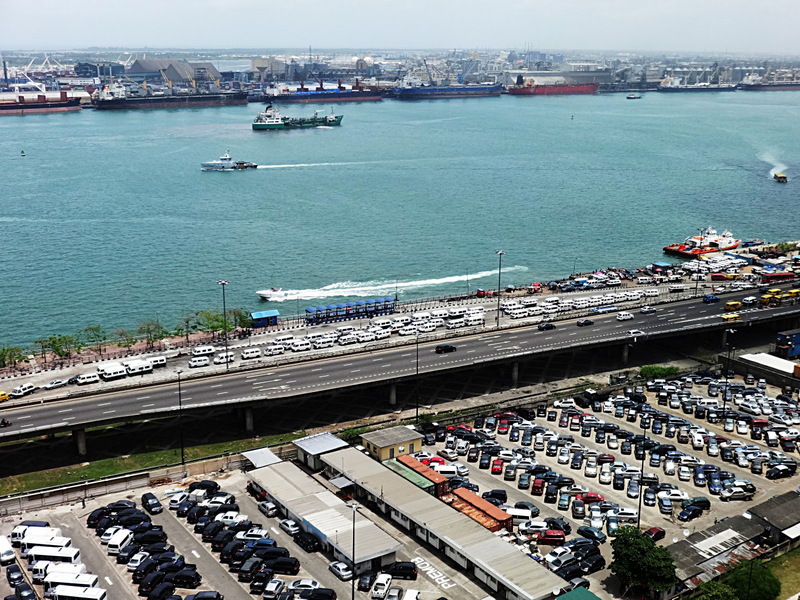
Apapa Port Complex in Lagos, Nigeria.
Credit: dotun55