
This week the UK Government, together with South Africa, the Children’s Investment Fund Foundation (CIFF) and British International Investment (BII) are hosting the Global Partnerships Conference. In the world of international development, partnership is one of those concepts which almost everyone will agree with, but can also mean very different things to different people.
Twenty years ago partnership in international development all too frequently meant ‘experts’ from ‘developed’ countries telling people in ‘developing’ countries what they had to do, regardless of whether or not they understood the cultural context and needs of the community. Thankfully that is rarely the case these days, but those narratives still exist, so defining what we mean by partnership is important.
So what should a genuine partnership built to tackle the shared challenges we face today look like? Looking at the recent experience of vaccine manufacture and distribution during the COVID-19 pandemic, we can say that partnership has to be intentional and it has to have equity built into it from the beginning rather than added on at the end to try and solve problems as they emerge.
Equity also requires those who have benefitted from unequal systems giving up power and building something new. The UK has a governance role in many of the institutions that make decisions on international development, so is in a strong position to do this. Genuine partnership requires sharing power in practice and not just rhetoric.
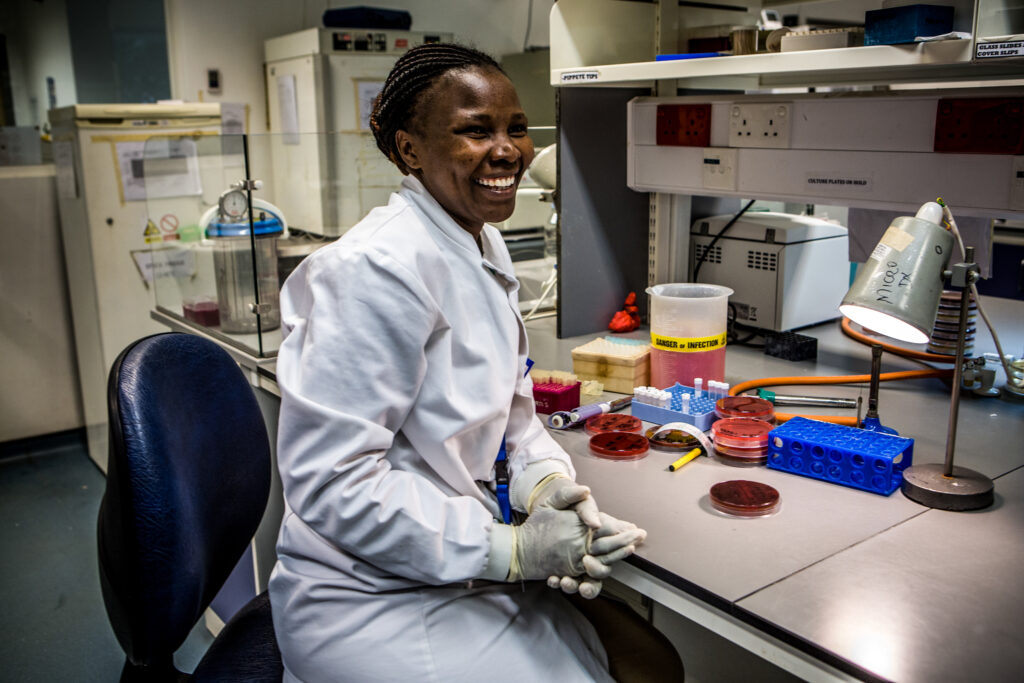
The Kenyan government with support from the GAVI Alliance, introduced a new vaccine, PCV-10, which targets 10 bacteria than can cause Invasive Pneumococcal Disease. Credit/Copyright: GAVI/2013/Evelyn Hockstein
Those of us in the UK will all remember the sense of relief and hope we felt when at 6.31am on the 8th December, 2020, 90‑year‑old Margaret “Maggie” Keenan, was vaccinated against COVID-19 at University Hospital Coventry. She was the first person in the world to receive such a vaccine outside of a clinical trial. This was a significant milestone as a path out of the global pandemic was now ahead. But this hope was not felt by everyone around the world.
The COVID-19 pandemic exposed fault lines in global health reminiscent of the HIV/AIDS crisis of the 1980s and 90s. Countries with less resources and with some of the weakest health systems were the ones burdened by delays and shortages in vaccine supply. The outcome was catastrophic. Modelling research estimates that if low- and middle-income countries had received vaccines earlier or at the same pace as high-income countries, more than half of deaths in these countries could have been averted.
There were attempts to improve vaccine supply and ensure that people in low and middle income countries could be vaccinated and they did help. However these efforts were battling long established systems and structures, as well as political and economic crises, and simply could not ensure equitable access. This, then, is an attempt at partnership that did not succeed.
So, in this post-COVID era, what can we now do to build equity and partnership into vaccine manufacturing so that we don’t repeat these mistakes? Where vaccines are made, who owns the technology, and who governs production are political choices that matter for everyone. Ensuring vaccines are owned and produced by countries across the world should be understood as a strategic necessity in this era of uncertainty. Pandemics, climate shocks, and supply-chain disruption linked to unstable governments, economies or conflict, and even vaccine misinformation, will all affect disease risk and burden. None of these interconnected threats will respect borders, and no single country can insulate and protect itself through national action alone.
There are new global policy frameworks that set the stage for reform, namely the WHO Pandemic Agreement, and the Lusaka Agenda and more recently the Accra Reset. These are important developments but these principles also have to also lead to structural change in how the research and development (R&D) processes for new diagnostics, treatments and vaccines work. The UK Government is already a strong supporter of the African Vaccine Manufacturing Accelerator (AVMA), to ensure that vaccines are produced more widely in the Global South. These initiatives need long term flexible financing. Genuine partnership also requires a focus on local ownership and long-term capacity, including for R&D to build sustainable pipelines.
Changing the address of a factory is not enough, nor is creating and owning vaccine technology in the Global North but putting it into bottles in the Global South. The best way to guarantee equitable access is through technology transfer, knowledge sharing, and locally-led R&D. We have to close these critical gaps by enabling full vaccine production in Africa in ways that ensure new technologies are shared broadly and affordably. This won’t always be easy, meaningful partnership rarely is, but it is absolutely possible and will save lives. It is also one of the ways that the UK can demonstrate what their new vision of partnership looks like.
Read our latest report: ‘Equity by Design’ here.