
On 5 May 2026, a healthcare worker in northeastern Democratic Republic of the Congo (DRC) fell ill with fever, haemorrhaging, vomiting, and severe malaise. Within days, the worker had died. It would take until 15 May for officials to determine the cause: the Bundibugyo virus, a rare and deadly strain of Ebola for which there is no approved vaccine and no approved treatment.
What has unfolded since is the 17th recorded Ebola outbreak in the DRC since the virus was first identified in 1976. However this outbreak is different in ways that demand serious global attention, as it has exposed how unprepared the world is to stop the spread of new diseases.
what is happening right now
As of 10 June 2026, the outbreak is highly active and continues to spread. The DRC’s Ministry of Health has reported 676 confirmed cases and 136 deaths, along with an additional 116 suspected cases. The virus has also crossed international borders, with 19 confirmed cases in Uganda and two confirmed deaths.
This rapid uptick in cases has prompted a significant response from international health authorities. On 17 May, just two days after the DRC confirmed the outbreak, the World Health Organization declared the outbreak a Public Health Emergency of International Concern (PHEIC) – the highest alert level they can issue.
This outbreak is particularly concerning to health authorities as there is very little research on this specific strain of Ebola. The 2014-2016 West Africa epidemic, which remains the largest recorded Ebola outbreak, was caused by the Zaire ebolavirus. This strain now has two vaccines that have significantly mitigated outbreak impacts.
This time, authorities are faced with the Bundibugyo virus – a virus with only two previously recorded outbreaks. It is an incredibly rare strain and has received such little research investment that scientists are essentially starting from scratch. As a result, there are no approved vaccines, no approved treatments, and limited clinical knowledge to guide response efforts. The fatality rate is approximately 30% to 50%, and with so little information, the stakes are extraordinarily high.
The WHO Director-General, Tedros Adhanom Ghebreyesus, put the issue plainly in a briefing on 25 May: “The epidemic is outpacing us.”
the deeper problem: pandemic preparedness
The 2026 Ebola outbreak is a tragedy unfolding in real time, but it is also a stark reminder of how the world has failed to learn from its past mistakes.
Following the COVID-19 pandemic there was widespread agreement that the world needed to do better. Disease surveillance and reporting systems need strengthening. Vaccine research and development needs more investment. Healthcare infrastructure, particularly in low- and middle-income countries, needs significant support.
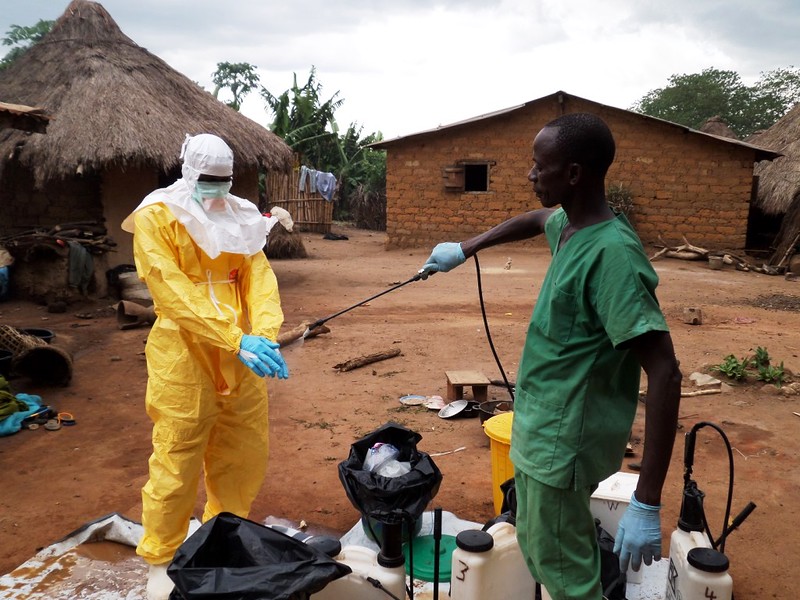
Healthcare workers disinfect each other during the 2014 Ebola outbreak in West Africa.
©EC/ECHO/Jean-Louis Mosse
While progress has been made in some areas over the past six years, it has become abundantly clear in this current outbreak that major gaps remain.
The absence of approved vaccines and treatments has left public health officials with limited tools to treat the disease and mitigate the outbreak. At the same time, healthcare systems in the DRC and neighbouring countries face enormous challenges responding to an outbreak of this scale. The healthcare infrastructure in these countries is unprepared to handle such a severe and widespread outbreak.
The urgency that surrounded pandemic preparedness during and immediately after COVID-19 has also faded. Public discourse around vaccines and measures to stop the spread of infections became increasingly polarised, fueled in part by misinformation and declining trust in public health institutions. As public attention shifted elsewhere, investments in preparedness became deprioritised amongst the public and politicians..
International politics have further affected global preparedness efforts. In March this year the UK Government announced its decision to pull funding from the Pandemic Fund, an organisation that provides grants to enhance pandemic preparedness in low- and middle-income countries where external support is critical. This decision followed the November announcement of a 15% cut in funding to the Global Fund to Fight AIDS, Tuberculosis and Malaria, an institution that finances global efforts to eradicate these three diseases. As governments reassess domestic and international priorities, global health programmes are frequently hit the hardest.
what next?
Amid this crisis, it is important to recognise the extraordinary efforts of the healthcare workers on the front lines. Doctors, nurses, contact tracers, and community health workers have worked tirelessly to care for patients and contain the spread despite limited resources and immense risk to their personal safety. Their dedication has been essential to response efforts, and mitigating this crisis would not be possible without their courage.
On 1 June, IAVI, a global nonprofit biomedical research organisation, announced their plans to develop a vaccine targeting the Bundibugyo virus using reallocated funding from the Government of the Netherlands. This represented a massive step in controlling the current outbreak, and further highlights the need for expert organisations to act decisively to prevent and respond to emerging health threats.
Yet this step is ultimately a reactive measure. The greater lesson from this outbreak is that ‘preparedness’ does not mean tackling a crisis only once it has started.
Governments must prioritise prevention as well as response. Sustained investment in research, disease surveillance, healthcare infrastructure, and international cooperation is essential to ensure future outbreaks can be contained before they escalate into large-scale public health emergencies.
This outbreak must serve as a reminder that preparedness requires ongoing commitment, and is not a lesson to be remembered only after a crisis has emerged.