
2026 marks 40 years of Results UK. To celebrate, throughout the year we are inviting contributors to write blogs exploring different ways of approaching and framing international development. In this fourth piece in the series, we hear from economists Michael Borowitz , Jinkou Zhao and Pascale Leroueil on the need to change the way global health multilaterals function in this new funding environment.
Since the start of 2025, Official Development Assistance budgets from countries like the UK, the United States and around the world have declined steeply. The response from the global health community has largely been to advocate for more money. That is necessary but not sufficient. The harder question around how much of what money remains is spent on the running costs of global health institutions rather than reaching patients is rarely asked with the same urgency. The answer should prompt action. Across the major global health institutions, there are processes and systems that either replicate each other directly or would deliver better value if combined. Identifying and consolidating them would free up resources and, in most cases, make the system work better for the countries it is meant to serve.
Health ministries are already living with the consequences. They are having the same conversations repeatedly with multiple institutions about the same topics: medicines, community health workers, supply chain, data systems. As the global health agenda moves toward primary health care integration, that fragmentation is directly counterproductive.
Governments need to plan health functions coherently across disease areas; the current architecture requires them to separate their planning by funding source instead. Universal health coverage is the destination this architecture should be building toward, and the fragmentation here is not incidental to that failure – it is structural.
where the duplication lives
Some of the inefficiency is straightforward duplication: the Global Fund, Gavi, the vaccine alliance, and UNITAID each maintain separate health financing departments, supply chain functions, monitoring and evaluation (M&E) systems, and data infrastructure, with country teams doing near-identical analytical work.
Some of it is duplication of process: recipient governments managing separate procurement relationships, reporting to separate M&E systems, and having the same conversations with multiple institutions about the same medicines and the same health workers. And some of it is foregone savings due to reduced buying power: consolidated supply chain functions would increase purchasing power across a combined portfolio in ways that separate functions cannot.
Not all processes should be consolidated. Immunisation policy, disease-specific investment decisions, and programme governance should remain distinct. Gavi’s immunisation expertise, the Global Fund’s disease-specific grant making, and UNITAID’s market-shaping role are not overhead. Preserving them while consolidating supporting functions is what makes the proposal politically viable – resistance has historically been strongest when reformers could not say clearly what would not change.
where to start: The Global Fund and Gavi health systems strengthening merger
Health financing and health systems strengthening are not separable at country level – both concern how services are organised, funded, and sustained. The most concrete and immediate first step is merging the health systems strengthening portfolios of the Global Fund and Gavi, which overlap most directly and whose separation imposes the highest coordination cost on governments.
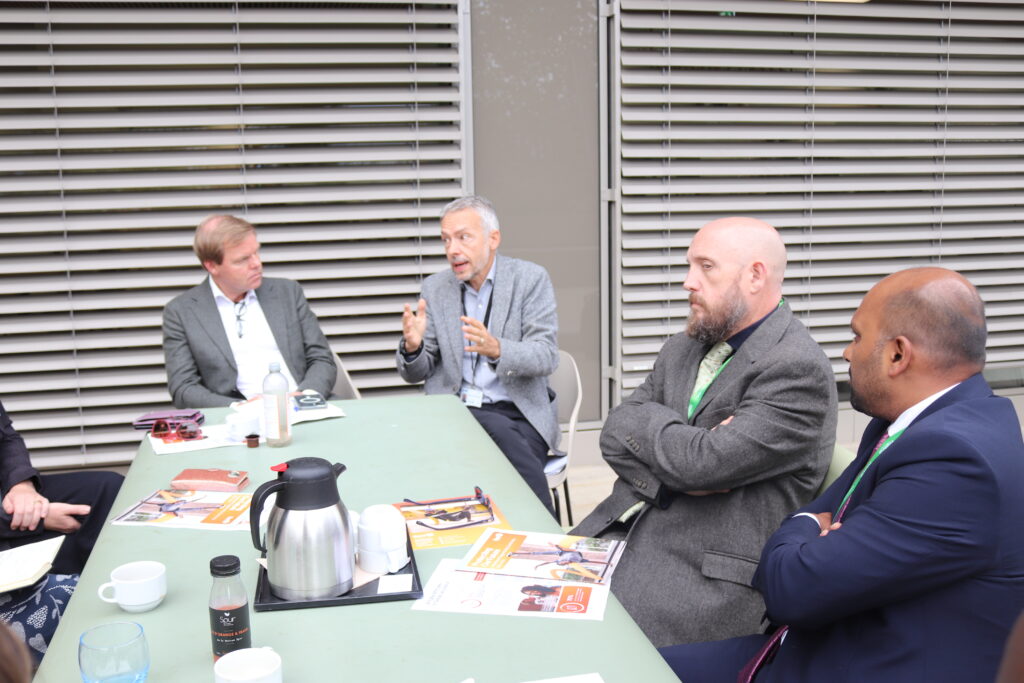
UK MPs speaking to staff from Gavi, the Vaccine Alliance on a delegation to the Global Health Campus in Geneva, 2025. Credit: Will Sewell / Results UK
other consolidation
The Global Financing Facility (GFF), currently a trust fund at the World Bank, should be merged into the Global Fund and Gavi. The GFF was created to catalyse health systems financing and align donor support behind national health strategies, which is the same work the Global Fund and Gavi are already doing at country level. Keeping it at the World Bank alongside a lending facility fragments what should be a coherent health systems relationship with governments and adds administrative cost without adding programming value. Several World Bank trust funds have already been partially consolidated; the GFF should be next, and the destination should be the institutions with the strongest country-level health systems presence.
why it has not happened
Institutional interests have presented themselves as principled objections. The argument that supply chain functions are too distinct to consolidate describes the current state, which is what consolidation changes. The argument that a shared M&E system compromises data quality cannot survive scrutiny when parallel systems produce comparable outputs at higher cost. The argument that consolidation threatens country ownership inverts the reality: governments managing relationships with multiple separate institutions simultaneously have less ownership, not more. Resistance will be strongest where secretariat influence depends on distinct programme identity, and weakest where board members already sit across institutions and see the duplication directly.
how to make it happen
Replenishment negotiations are the leverage point. Donors contributing to institutions across global health are in a position to make consolidation of shared functions a condition of the next replenishment cycle. The proposal should be specific and time-bound: consolidate health systems and financing – beginning with the Global Fund and Gavi HSS portfolios – supply chain, and M&E within a defined timeframe, with programme governance and disease-specific decisions remaining separate. Governance consolidation is harder and belongs in a later phase, but cannot be treated as optional; institutions that share back-office functions while maintaining entirely separate governance will find the country-level fragmentation persists in a different form.
Recipient governments have standing to push for this too; the transaction costs of the current arrangement fall disproportionately on them, and their voice in replenishment and governance processes carries weight that is often underestimated.
When the question was how to spend more, fragmentation was a management problem. When the question is how to spend what remains as effectively as possible, it is an ethical one. Every dollar consumed by duplicated back-office functions, parallel country teams, and separate reporting systems is a dollar not reaching a health worker, a medicine, or a patient. The architecture exists to serve that purpose. Where it does not, it should be changed.
Michael Borowitz is the former chief economist at the Global Fund; Jinkou Zhao is affiliated with the Fudan Institute of Advanced Studies in Global Health and Institute of Global Health, University of Geneva; Pascale Leroueil is the Director, Commercial Sector at ThinkWell.