

Kirsty O’Connor / No 10 Downing Street
make the case for aid, Andy!
We have a new prime minister who is in the early stages of setting the agenda for his government. This moment provides a key opportunity to shape the UK approach to international development. Andy Burnham can stand up for those in greatest need – both in the UK and globally – by vocally championing international development. We need to make sure that he understands how global development meets his ‘Makerfield Test’ so that he can set out a clear path to increasing funding for ending global poverty.
what
the new PM has said that any government policy has to show how it benefits the people of his constituency, Makerfield
who
public support for development can persuade the new PM to make the case to the country and set out a clear timeline for additional spending
how
write directly to the prime minister to make the message loud and clear
a time to change the narrative
A new government taking office offers the chance of a new policy direction. Ed Miliband – the new Foreign Secretary – has said that international development will be central to UK foreign policy and has shown his personal commitment by representing the UK at the World Bank.
However we have also seen that development spending remains under threat and may be used to fund new domestic priorities. Also, just before Keir Starmer left office, the Foreign Commonwealth and Development Office published its annual report, setting out the details of the cuts to individual countries and the devastating impacts that this will have, particularly in Africa. For example the Democratic Republic of Congo (DRC) will see its budget reduced by over £34 million despite facing a deadly Ebola outbreak amidst a decades-long civil war.
This approach can be changed but it is essential that he makes the case to the country about why investing in global health and education benefits the UK.
As Dr Beccy Cooper MP argued in her recent blog for Results UK: “strong health systems abroad make Britain safer and more prosperous at home. This is not charity. It is self interest.”
This argument is particularly important because Andy Burnham has already stated that he will be applying the Makerfield Test to any proposed government policy. If it does not benefit the people of Makerfield and communities like it across the UK then it cannot proceed. While ODA spending can absolutely meet this test, it is important that he as the prime minister publicly makes this case – celebrating both the good that UK ODA spending can do in the world and how it benefits at home.
demand real change
Writing to the PM shows both that the public both supports spending on international development and that people are watching what he does on this issue. It creates the political space for him to act but also reminds him that there are consequences of failing to do so. Every interest group in the country will be trying to get Andy Burnham’s attention, therefore it is important to act now so that he hears loud and clear that the UK public want to see a clear plan on how increased development spending will be achieved.
take action now!
Please write to the prime minister to:
Explain to him the benefits of investing in global development and how it passes his ‘Makerfield Test’.
Address: The Prime Minister, Rt. Hon. Andy Burnham MP, 10 Downing Street, London, SW1A 2AA. Physical letters get noticed!
Email: [email protected]
Online contact form: https://contact.no10.gov.uk/ (this doesn’t allow much space unfortunately)
NOTE: Don’t use the prime minister’s constituency or Westminster email addresses, as your letter will not be forwarded to him unless you live in his Makerfield constituency.
Social Media: @andyburnham on X and @andybunrham.bsky.social on bluesky.
Copy your letter to your MP, so that they also see that their constituents want bolder political action on development. Find their contact details here.
Want tips on how to write a good letter? Use this guide.
Thank you for taking action!
take action!
WRITE to the PM and explain why development spending passses his Makerfield Test
ASK him to set a clear timeline to increasing spending on international development
we’re here to support you!
If you have any questions or need support or advice in writing your letter, please contact Will Sewell, Senior Campaigns and Communications Officer, at [email protected]
investment in UK research and development continues to save lives
Many of us benefitted from the Astra-Zeneca COVID-19 vaccine that was developed by scientists in Oxford. It is estimated that it saved 6 million lives in just its first year of use. Now the same technology is being used to fight the new strain of Ebola – Bundibugyo virus disease (BVD) – that has caused nearly 1000 deaths in the Democratic Republic of Congo. This outbreak – declared a public health emergency of international concern by the World Health Organisation in May, has been a particular concern as there were no vaccines for this new strain.
In just eight weeks, scientists in Oxford have used the technology they developed for the COVID vaccine to develop a new experimental vaccine for BVD. However the incredibly quick response was only possible because of global partnership and decades of investment in research.
Ed Hunt – a 37-year-old UK man – is the first person in the world to receive the new vaccine against the BVD strain of the Ebola virus. He is the first of 50 healthy volunteers aged 18-55 being recruited for the trial that will test for safety and to see if the vaccine triggers an immune response. Further trials will then be carried out in DRC and other areas affected by this new strain of Ebola.
Read more about Ed’s story here.
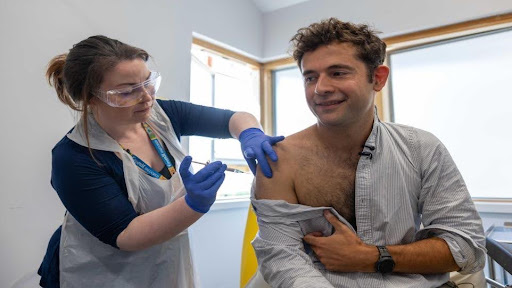
Ed Hunt receiving the Ebola vaccine in Oxford. Source: BBC